Dhedge vault managers: Roles and permissions
Dhedge vault managers set vault policy and authorize trading while the vault contract holds depositor assets. A manager can execute trades directly and appoint a trader address, retaining control over fees and manager replacement. Delegation also has adjustable boundaries: asset-list editing is enabled by default, while privacy changes require separate permission. The trader can set the vault-share supply cap checked during deposits, so disabling asset edits doesn't remove every administrative power. Chamber continues the protocol under its new name; its April 26, 2026 rebrand announcement confirmed that continuity. The manager also controls private-vault membership, so approval to deposit doesn't itself grant permission to trade pooled assets.
On this page
Separate addresses for custody and authority
In a V2 vault, the manager address controls settings, the trader address handles delegated execution, and the vault address holds assets. The manager signs privileged configuration changes, and the trader signs permitted trading calls. Depositors own vault shares, which represent their interest in the pooled strategy. Neither operational role gives its holder a general right to withdraw another depositor's position.
The vault remains on its deployment network. Changing an authorized address doesn't move the portfolio to another chain or create a replacement vault.
Which settings can a delegated trader change?
A trader's enabled permissions determine whether it can edit assets or switch privacy, alongside its trading and supply-cap powers. Between these roles, the manager alone can change fees, set the minimum deposit, or replace the manager address.
New V2 vaults start with asset-change permission enabled. With it enabled, a trader may add supported assets that the manager hasn't individually selected. Disabling it confines the trader to the existing enabled set, while the manager retains asset-list control. Protocol validity and asset-removal checks apply to both roles. An enabled asset needn't already have a balance in the vault.
Privacy permission starts disabled. Enabling it permits the trader to switch public or private deposit access; it doesn't grant control of the manager-maintained address membership list.
The supply-cap function separately accepts calls from either the manager or the stored trader. Its authority doesn't depend on the asset-change or privacy toggles. A delegation restricted to existing assets can therefore still affect future deposit capacity. The deposit-minting check counts newly issued depositor and fee shares against that cap. Performance and management fee minting outside deposits can still take supply above it.
Private-vault membership and admission
Private admission can use the manager's address membership list and, where configured, ownership of an NFT from the selected collection. The V2 membership function accepts either route. Removing an address from the list therefore doesn't block someone who still qualifies through the collection. Existing depositors keep their shares when access changes, and ordinary withdrawal conditions continue to apply. Public admission removes the membership requirement without removing the vault's other deposit checks. The privacy setting controls entry eligibility; it doesn't assign trading authority.
Replacing a trader and checking the handoff
When execution needs to move to another wallet, Set Trader replaces the delegate without transferring manager authority. Check the stored trader and both permission flags before a time-sensitive handoff.
| Handoff stage | Manager action or recorded change | Authorization boundary |
|---|---|---|
| Manager access | Open Set Trader in the existing vault's settings. | Only the current manager can assign the trader. |
| Execution address | Enter the intended replacement trader address. | Set Trader rejects the zero address. |
| Asset scope | Choose whether the trader may change enabled assets. | New assets still need protocol support. |
| Privacy scope | Choose whether the trader may switch deposit privacy. | This permission starts disabled. |
| Authorization | Confirm the change from the manager wallet. | Signing alone doesn't establish a changed role. |
| Recorded replacement | Successful execution stores the replacement trader address. | One active trader remains; the previous address loses its trader role. |
| Handoff confirmation | Read the stored trader and both permission settings. | The active address must match the intended trader. |
A completed handoff has the intended address and chosen permission flags recorded onchain. Changing the trader address alone doesn't reset those flags. Neither a wallet prompt nor a submitted transaction establishes that state.
If trader replacement fails, the stored trader address remains unchanged. Repeat the state check before retrying; Remove Trader offers a separate path when the intention is revocation.
Remove Trader clears the delegate. Pasting the zero address into Set Trader fails, so it doesn't serve as a revocation shortcut.
Fee authority, announcements, and activation
The trader role excludes fee changes; managers can change rates within protocol caps and the applicable timing rules. The entry, exit, performance, and management fees each have configurable protocol limits. A manager can lower the rates through the direct fee-setting function, provided none of the submitted rates increases. Asset permissions don't alter those requirements.
A manager's announced fee increase requires the configured waiting period and a successful commit before it becomes active. The activation timestamp marks the earliest permitted commit, so time passing alone doesn't apply the new schedule. The manager may cancel an announcement before committing it. Performance fee increases also face a configured maximum change; waiting doesn't authorize an otherwise oversized increase. Separately, the factory owner has an administrative fee-setting path that bypasses the announcement delay while retaining the configured fee caps.
Manager replacement transfers configuration control
A successful manager-address change gives the destination account the manager role, so control of that account determines continued administrative access. V2's
changeManager
function rejects a zero address and records the new manager directly. It doesn't require a separate acceptance transaction from the destination. A nonzero address can pass that check even when the intended operator can't control it.
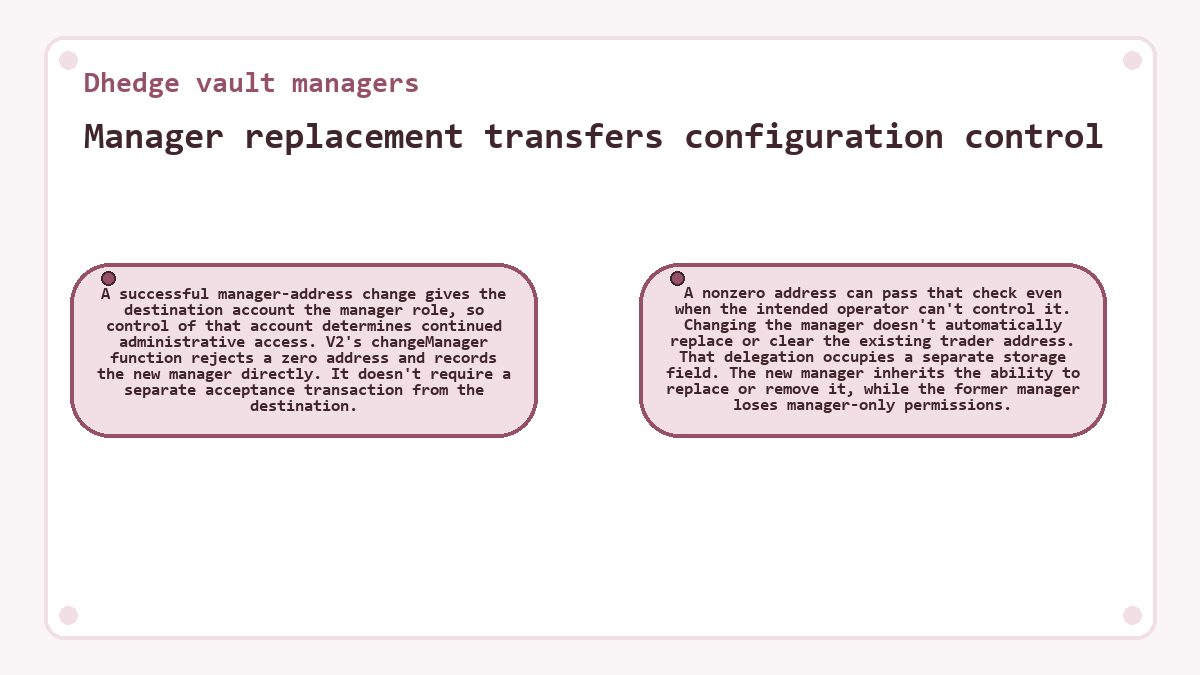
Changing the manager doesn't automatically replace or clear the existing trader address. That delegation occupies a separate storage field. The new manager inherits the ability to replace or remove it, while the former manager loses manager-only permissions.
Trading permissions still leave strategy risk
Managers and traders face the same trading guards, which restrict external actions without judging whether a permitted trade is profitable. Contract guards validate allowed interactions; asset guards account for supported positions and their withdrawal behavior. Manual trading and automated strategies both use that contract-enforced boundary.
A delegate can make a poor allocation or trade at an unfavorable price while remaining inside the vault's rules. Losses in an integrated protocol can also affect the vault's positions. Narrower permissions reduce the actions available to a trading key, but they don't undo completed transactions. Those restrictions apply to the trader role; anyone controlling the manager wallet also holds the manager's broader administrative powers.
Useful questions about Dhedge vault managers
-
Does the manager need whitelist approval to deposit into a private vault?
- The current manager address can deposit into a private V2 vault without address-list or NFT membership. Other deposit checks still apply, including deposit-asset eligibility and the configured minimum. The exemption follows the manager address; it doesn't automatically extend to the delegated trader.
-
Can a trader reduce the supply cap below existing vault supply?
- A trader can't set a nonzero supply cap below the vault's existing token supply. V2 applies the same condition to the manager. Setting the cap to zero removes that limit. The contract measures this cap in vault-share units, so it shouldn't be read as a fixed ceiling on the portfolio's dollar value.
-
What happens to previously minted fee shares when the manager address changes?
- Previously minted fee shares remain in the wallet that owns them when the manager address changes. The role-change function updates administrative authority and the stored manager name without transferring existing token balances. Control of the vault's settings and ownership of those shares are separate.
-
How does the minimum-deposit setting affect an existing holder's top-up?
- In the V2 deposit path, the minimum checks the recipient's resulting USD-valued vault holding after the deposit. It doesn't compare only the added amount with the manager's setting. Smaller top-ups can satisfy that test when the resulting holding clears the threshold, while other deposit constraints continue to apply.
-
Can the manager's displayed name change without transferring control?
- The V2 changeManager function can keep the current manager address while updating the stored manager name. Signing authority stays with that address. The manager name is separate from the vault's name and token symbol, which remain fixed after deployment.
Last updated ·